
Tornado Strikes Topeka
From the Winchester Star, July 10, 1966, John P. Hoskinson, editor and reporter
As evening came on yesterday, June 8, the most devastating tornado to touch down in Kansas for many years, exploded the old myth that "Burnett's Mound" warded off such storms from our Capitol City.*
Striking the earth near that particular mound, the giant funnel moved in the traditional Northeasterly path across the heart of the city and left the area near the municipal airport.
Many messages are, at this time, being broadcast over the air WIBW-TV and radio to anxious relatives about those in the disaster area. We have heard many for persons in the Winchester area.
No newspaper for June 9 has come out of the city, since the news plant was in the path of the storm. Radio and TV have done a splendid job of reporting and are continuing to give all information received by them.
Damage was done to the dome of the State Capitol Building which was directly in the tornado path. Millions of dollars damage was done over the city.
At this time, 12 are dead, over 500 received treatment at the city hospitals.
The storm's path was over 1/2 mile wide and 15 miles long from Southwest to Northeast.
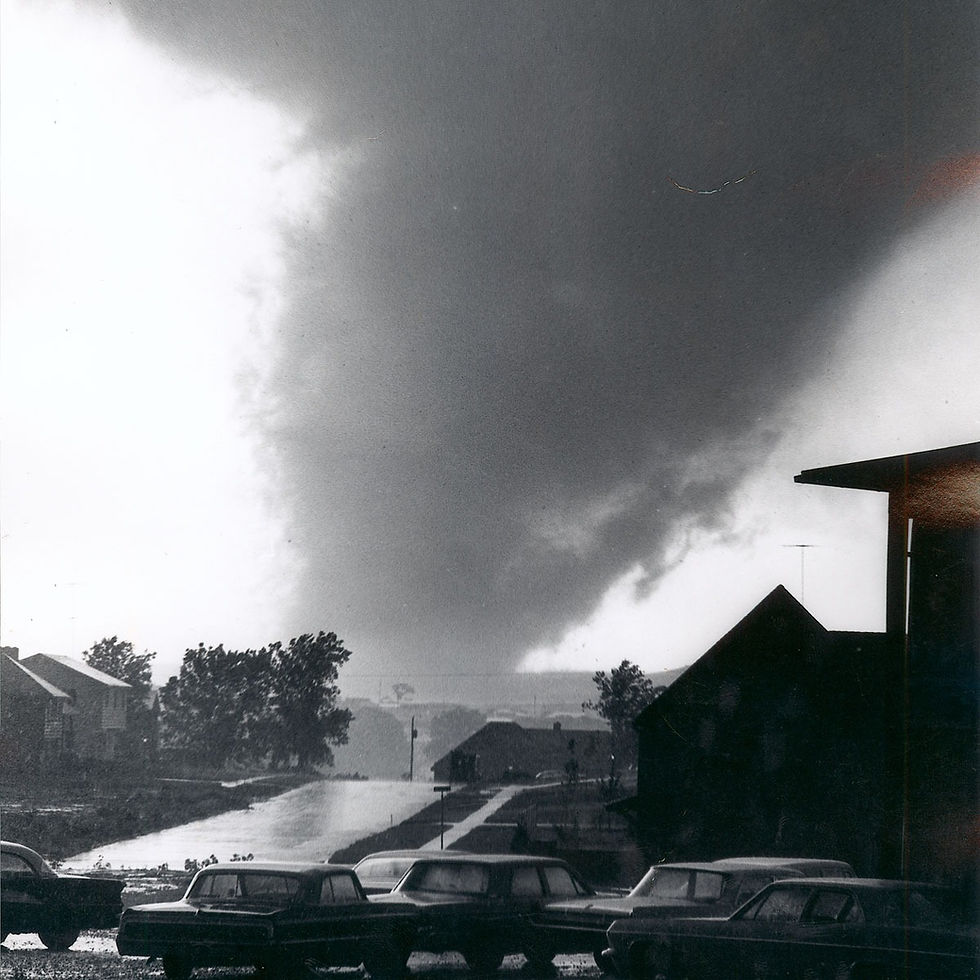
Tornado Damage Heavy
Destruction Unbelievable
From the Oskaloosa Independent, July 16, 1966, John P. Hoskinson, editor and reporter
"Life went on as usual in much of Topeka Sunday, except that spectators crammed the top of Burnett's Mound to peer at ant-sized humans grubbing through piles of debris."
This is the way Ralph Marsh of the Topeka Capitol expressed it. This is the way we saw it. The Capitol City was making head-way in digging out. The helpless frustration of earlier hours was waning, but only because they were seriously involved in attempting some order out of chaos. There was work to be done to clean up after last Wednesday and the giant funnel cloud which ripped the heart out of a great city.
The most destructive tornado to strike Kansas in many years came out of the skies over Burnett's Mound and swept a path 1/2 mile wide for 8 miles in a northeasterly direction across the city, crossing from the southwest corner of the city over the Washburn University campus and then moving down town to 10th and Kansas Avenue. Then it crossed at the east end of the 6th Street viaduct into Oakland and left the city at the northeast corner, crossing the municipal airport.
In its wake 16 are dead in the city; over 450 are injured. Damage is now placed at more than 100 million dollars. Many are homeless. The storm path resembles a war ravaged city after a heavy air raid or shelling. It is impossible to describe.
We of the outlying areas are deeply indebted, for the information during and after the storm, to the dedicated newsmen of press and radio.

The stately old "Cottonwood" tree which stands at the southeast corner of the state house was heavily damaged. This tree has been pictured in many text books and pamphlets about our state. Its future, at this time, is in doubt. Only a few of its major limbs remain on the 8 ft. trunk. The state forestry men have trimmed the branches and patched up a split in the trunk. A forced feeding program has been established for the tree in an effort to save it and in the hopes the remaining limbs will leaf out.**
Shortly before the Topeka disaster a tornado struck Manhattan, Wakefield, and the Ft. Riley Military Reservation. Extensive damage was reported from those areas. It then moved eastward touching down near Dover, Southwest of Topeka, and more or less remained on the ground for 15 miles as it passed on into and through Topeka.
DAMAGE IN JEFFERSON COUNTY
The storm entered Jefferson County southeast of Grantville damaging the Chas. Tucker farm buildings before rising into the clouds.
Next touch-down was reported on the Davis and Harold Courter farms near Wellman Chapel where heavy damage was done to out buildings and the wood-shed at Wellman School destroyed. Moving on eastward damage was done south of McLouth to the barns and outbuildings of Richard Peine, Don Robbins, Bob Henson, Fred Richman and Delbert Lobb. At this point it passed on into Leavenworth County.
DAMAGE IN LEAVENWORTH COUNTY
We quote from the Leavenworth Times:
Tornado funnels snaked out of the sky over Leavenworth County Wednesday night, dealing death to 65-year-old William Bachuss west of Tonganoxie and destroying or damaging at least 33 structures, many of them in the Jarbalo area.
Mr. Bachuss and his wife, Nellie, were standing in the doorway of their small frame home when the storm hit, said their son, Bill Bachuss of Kansas City, Kansas.
Mr. Bachuss was killed. His wife's right hand was mangled, her son told The Times, and she was taken to Bethany Hospital, Kansas City, Kansas, in shock.
The Bachuss automobile which had been parked in front of the house was hurled more than 1,000 yards. It was a battered hulk, the rear end ripped away and tossed another 25 yards distant.
Miraculously only one woman was reported injured at Jarbalo, where a tornado knifed across the edge of the rural community. Mrs. Esther Jeanin, 71, was pulled from under a flattened house trailer and taken to St. John Hospital in Leavenworth.
DEBRIS PICKED UP
Bits of insulation, pages of University information, full sheets and pieces of ply wood, clothing, lamp shades, checks, letters, and other miscellaneous articles have been picked up all over Jefferson County. Debris has been reported found at least 30 miles east of St. Joseph, Mo.
The debris is mixed, mostly out of the Topeka area; however, letters from Wakefield and Manhattan have been found here. A white cake with chocolate icing, on a paper plate with a picture of the Kansas Capitol building, was found in almost perfect condition 4 1/2 miles east of St. Joseph, Mo. An offset printing plate from a yearbook was found north of Winchester.
COUNTY CREWS HELP Jefferson County highway trucks and men were put to work in Topeka last Friday and Saturday. On Friday, 8 trucks and 12 men were sent, and on Saturday, 6 trucks and 9 men. Their work area was in and around Central Park.
COURTHOUSE OPEN DURING ALERTS
The Jefferson County Commissioners have given the authority to the sheriff's office to open the Court House basement in a tornado alert. The basement is already a civil defense air raid shelter and will have room for several hundred persons in a tornado emergency. Anyone desiring to use the basement, when a tornado is reported in the area, may do so.
"The grass is moving, the trees are moving, the whole earth is moving..." — Traditional Potawatomi Song
*Some locals still wonder if the 1966 tornado happened because the city ignored an urban legend. This local legend originates from a holy man of the Potawatomi tribe named Wis-Ki-Ge-Amatyuk, (Chief Abram Burnett), who lived around the turn of the 20th century. As the story goes, a horrible storm on the prairie killed and injured a number of tribal members. Seven of the victims were allegedly directly related to Chief Abram Burnett. The tribe decided to try and prevent a tragedy like this from happening again. They asked the Great Spirit to bless the burial mound with the ability “to stop the powerful spinning winds,” watch over the dead that had been laid to rest there, and protect the community that survived. And so the mound stood until 1960, when the city cut into its north side to construct a water tank. More development followed in the following years. So was it a coincidence that just six years later, an infamous tornado ripped through the town?
From The Mythology of Burnett's Mound, NPR, KUCR: https://www.kcur.org/history/2025-10-29/topeka-kansas-tornado-burnetts-mound
Today, Burnett's Mound is a feature of Topeka's Skyline Park, with exhibits highlighting the Potawatomi Nation's history and presence in Kansas. The park offers 4.47 miles of walking trails and panoramic views of Shawnee County.
** In 1983 Jack Brier, then secretary of state, made every effort to "save the cottonwood" from disease and damage. Large limbs on the 90-foot cottonwood were supported by wires attached to the 15-foot circumference of the trunk. In spite of Brier's efforts, the tree finally succumbed to more winds in 1984 and had to be removed. The old tree was revered for many years. U.S. presidents are said to have spoken from beneath its wide branches. A plaque marks a young cottonwood tree that has been planted near the same spot where the parent tree once stood. Cuttings had been taken from the original tree and nursed along by the grounds crew. While the original tree is gone, a direct descendant grows today in its place.
From Kansas State Capitol - Cottonwood Tree: https://www.kansashistory.gov/kansapedia/kansas-state-capitol-cottonwood-tree/11746


